Dinosaurs are cool.
I, for one, have always wanted to ride a velociraptor, guns blazing
as I vanquish my enemies.
 |
| well, president nixon beat me to it Source: |
But sadly, it’s never going to happen. These awesome
reptiles that dominated the land for over 135 million years were completely
wiped off the face of the planet.
About 66 million years ago, a giant asteroid
about the size of Manhattan crashed through earth’s atmosphere onto the shores
of what we now call the Gulf of Mexico. The energy of the impact itself vaporized
everything within a days walk, before its fragments were thrown up into the
atmosphere and rained back down in the style of the doomsday Armageddon. The
dust and ash cloud that was vaulted into the atmosphere then obscured the
surface of the earth from sunlight for decades, creating a dim, cold climate
plagued by acid rain and firestorms. It caused 98% of corals to die, 60% of all
plant life to vanish, and of course, 100% of the dinosaurs. It was a cataclysm
that markedcr the end of an era: the Mesozoic era. source
 |
| So you've had a bad day. Source: astrobio.net |
Needless to say, it was a bad time to be alive.
For most of us, however, it has become our only explanation for
why the dinosaurs became extinct. This is to be expected; after all, we
commonly associate giant city-sized rocks plummeting from the sky with death. However,
new studies have shown that that asteroid impact may have been just one of a
few competing factors, and that it may not have been the sole cause of the
extinction.
But before we get into that, we must learn about the reasons
why this meteorite has become so famous:
Climate change
The at around the time the extinction occurred, the climate
changed.
A lot.
This isn’t your Canadian spring we’re talking about, we’re talking
about life demolishing, climate upheaval.
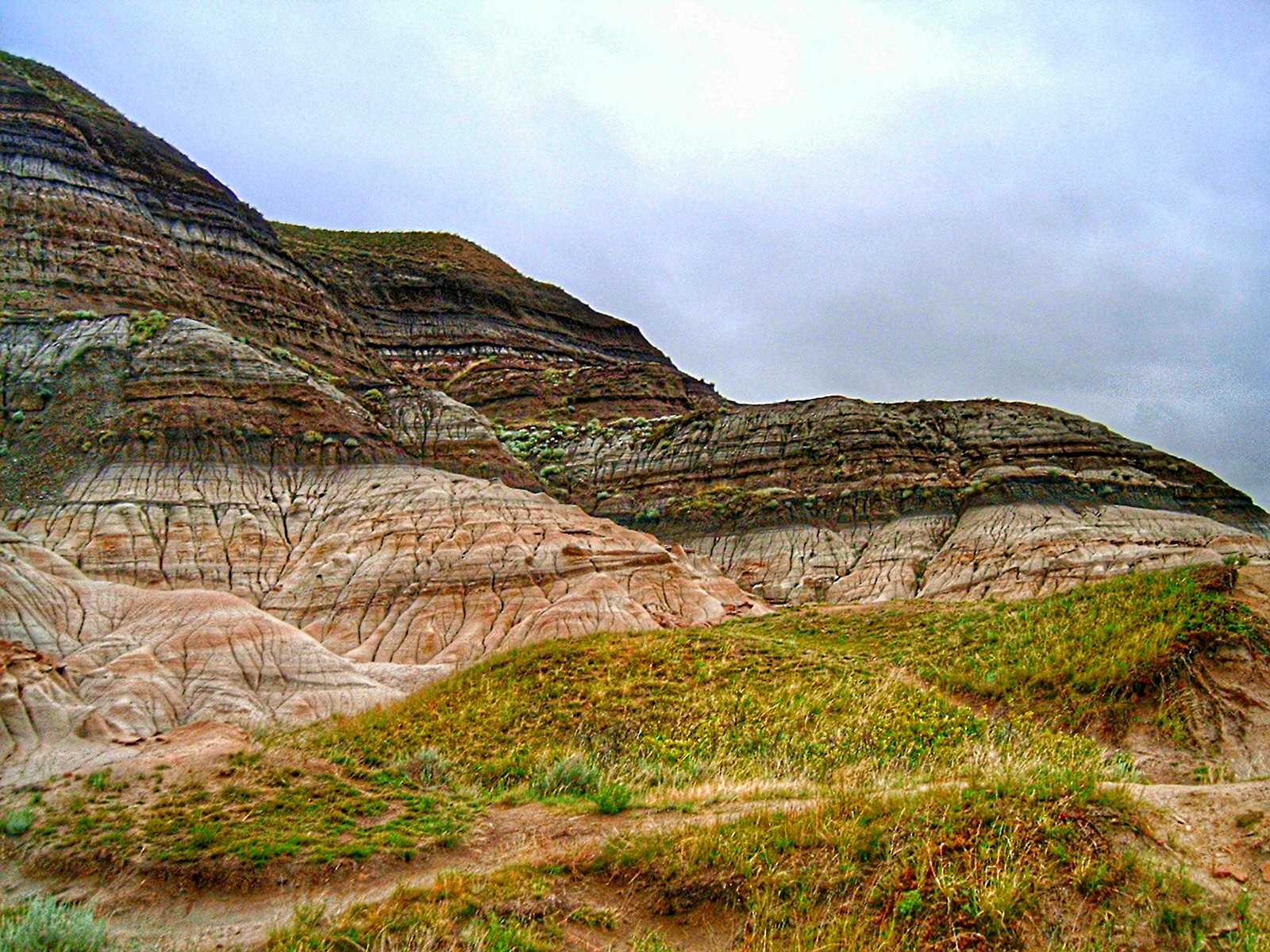 |
| Cretaceous Paleogene Boundary Exposed via Erosion Source: http://en.wikipedia.org/wiki/Cretaceous%E2%80%93 Paleogene_extinction_event#/media/File:KT_boundary_054.jpg |
By comparing the types of marine fossils before and after
the event, and by testing changes in soil quality, we have discovered that the earth
cooled dramatically during this time, by 7 degrees Celsius during this time. This
change was so abrupt that it is extremely easy to spot within the rock record
of the earth, known as the Cretaceous-Paleogene boundary.
Now this boundary is a clue in itself. This layer of clay
came up in nearly the exact same time all around the world, but in addition to
that, there is one more thing that hints at an asteroid impact.
This layer of clay was very, very rich in…
Iridium
 |
| The intermediate layer contains 1000 times the amount of iridium than in competing layers. Source: San Diego Natural History Museum |
Iridium is extremely rare on earth. As such, most supplies
of iridium are found on meteorites. The sudden spike in concentration of
iridium throughout the rock record can only be explained by the fact that a
meteor bombardment happened and spread its compositions throughout the planet
at that period of time, to be forever preserved within this Cretaceous-Paleogene
boundary. When scientists measured the amount of the compound within this
boundary, it was found to be hundreds of times higher than normal. Luiz Alvarvez,
a Nobel-Prize winning physicist, hypothesized that it was a sign of an enormous
asteroid impact. source
Eventually, people were just finding evidence of an asteroid
impact everywhere.
Shocked Quartz
 |
| Shocked Quartz Source: |
At boundary sites around the world, the molecular structure
of the quartz seemed to be rearranged by tremendous amounts of pressure you’d
never expect to find on the surface of the planet. Source In addition, scientists also
found something more:
Tektites
 |
| Tektites source: |
Aside from looking like black peanuts, Tektites are small chunks of rock that are thrown up into
the atmosphere and then melt upon re-entry. Source
In other words, all the evidence pointed directly towards a
huge, ugly, cataclysmic collision. This passed into historical fact, and it
became the quick and easy answer to what killed the dinosaurs.
While you may not find many scientists saying that the
asteroid impact never happened, you will find lots of scientists that say it
may not have been the sole factor of the extinction. In fact, many believed that
the extinction began much earlier, and that the asteroid was simply the final,
killing blow.
Volcanos
It turns out, for instance, that the impact occurred in the
middle of the most severe volcanic activity earth has ever seen. The Deccan Traps flood basalts in India and suggest that they were formed by a series of violent reactions
between 500 thousand to a million years before the asteroid impact, and would have
continued for hundreds of thousands of years afterwards.
 |
| Deccan Traps Credit: Maria Keller |
Such violent,
prolonged reactions would have had an unmistakable effect on the climate,
obscuring sunlight, killing vegetation, and altering weather patterns around
the world. Since Dinosaurs were most likely cold blooded, they would not have
been able to adapt quickly enough to the drastic change in weather patterns, causing
them to die off even before the asteroid impact. these eruptions may have spewed poisonous levels of sulfur and carbon dioxide into the atmosphere and caused the mass extinction through the resulting global warming and ocean acidification. Source
But that’s just one side of the scenario. In addition to
space rock impacts and massive volcanic eruptions, it also seems that the oceans
were disappearing.
Marine Regressions
 |
| The western seaway may have just disappeared source: |
Around this time period, the usually dynamic tectonic plates
just stopped moving. And as they settled, they sank deeper into the earth’s
mantle, causing ocean levels to fall. And when ocean level fall, they come with
massive impacts to life on earth.
Marine regressions don’t happen often, but when they do, it
is often accompanied by massive changes to the earth’s geography. Inland seas,
like the western seaway that used to run through ancient north America, completely
disappeared, and more than 28 million square kilometers of land suddenly became
exposed in less than one hundred thousand years.
This caused massive extinction
events both on land, as life was deprived of its water sources, and within the water,
as the water receded to uninhabitable levels, oftentimes vanishing altogether. The loss of these seas greatly altered habitats, removing costal plains that ten million years before had been hosts to diverse communities. This would be why fossils show enormous die-offs in plankton tens of thousands
of years before the asteroid impact. Source
Conclusion:
The asteroid explanation is fun. It's easy to just say that "a giant rock hit them" when eight year olds ask where the dinosaurs are. But it is also important to know that it was just one of many factors. Even if the asteroid never hit, chances are, the extinctions may have occured anyway. The meteor strike was simply just the nail in the coffin, sealing the fate of the dinosaurs with a quick and decisive end.
Now, this is all cool and everything, though I'm still kind of sore at how I don't have my own pet triceratops yet
 |
I'll just go with this for now:
