Friday, 29 May 2015

What happened to my pet dinosaurs?


Dinosaurs are cool.

I, for one, have always wanted to ride a velociraptor, guns blazing as I vanquish my enemies.

well, president nixon beat me to it
Source: sharpwriter.deviantart.com

But sadly, it’s never going to happen. These awesome reptiles that dominated the land for over 135 million years were completely wiped off the face of the planet. 

About 66 million years ago, a giant asteroid about the size of Manhattan crashed through earth’s atmosphere onto the shores of what we now call the Gulf of Mexico. The energy of the impact itself vaporized everything within a days walk, before its fragments were thrown up into the atmosphere and rained back down in the style of the doomsday Armageddon. The dust and ash cloud that was vaulted into the atmosphere then obscured the surface of the earth from sunlight for decades, creating a dim, cold climate plagued by acid rain and firestorms. It caused 98% of corals to die, 60% of all plant life to vanish, and of course, 100% of the dinosaurs. It was a cataclysm that markedcr the end of an era: the Mesozoic era. source
So you've had a bad day.
Source: astrobio.net

Needless to say, it was a bad time to be alive.


For most of us, however, it has become our only explanation for why the dinosaurs became extinct. This is to be expected; after all, we commonly associate giant city-sized rocks plummeting from the sky with death. However, new studies have shown that that asteroid impact may have been just one of a few competing factors, and that it may not have been the sole cause of the extinction.

But before we get into that, we must learn about the reasons why this meteorite has become so famous:

 Climate change

The at around the time the extinction occurred, the climate changed.

A lot.

This isn’t your Canadian spring we’re talking about, we’re talking about life demolishing, climate upheaval.
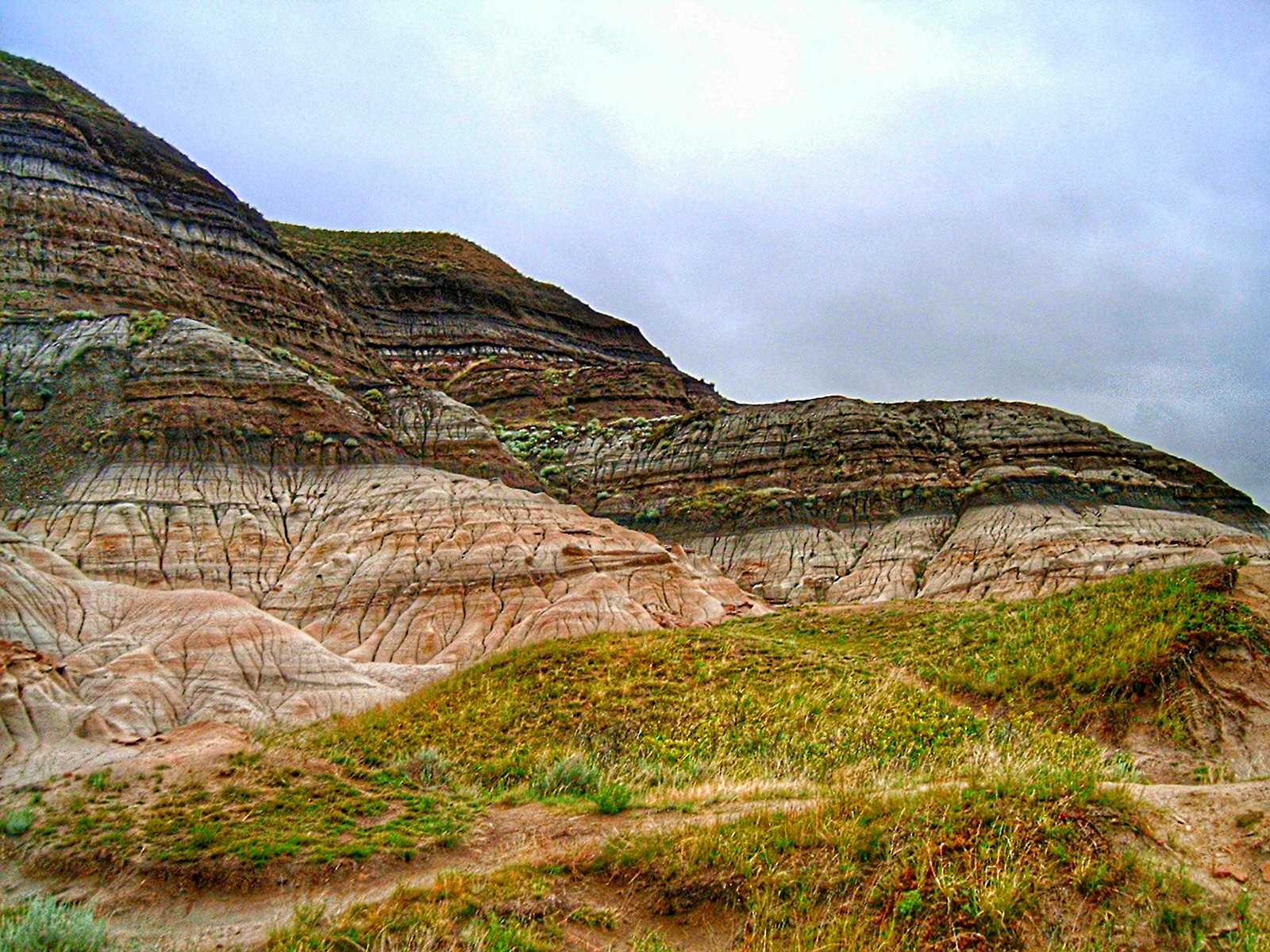
Cretaceous Paleogene Boundary Exposed via Erosion
Source: http://en.wikipedia.org/wiki/Cretaceous%E2%80%93
Paleogene_extinction_event#/media/File:KT_boundary_054.jpg


By comparing the types of marine fossils before and after the event, and by testing changes in soil quality, we have discovered that the earth cooled dramatically during this time, by 7 degrees Celsius during this time. This change was so abrupt that it is extremely easy to spot within the rock record of the earth, known as the Cretaceous-Paleogene boundary.


Now this boundary is a clue in itself. This layer of clay came up in nearly the exact same time all around the world, but in addition to that, there is one more thing that hints at an asteroid impact.
This layer of clay was very, very rich in…

         Iridium

The intermediate layer contains 1000
times the amount of iridium than in
competing layers.
Source: San Diego Natural History Museum
Iridium is extremely rare on earth. As such, most supplies of iridium are found on meteorites. The sudden spike in concentration of iridium throughout the rock record can only be explained by the fact that a meteor bombardment happened and spread its compositions throughout the planet at that period of time, to be forever preserved within this Cretaceous-Paleogene boundary. When scientists measured the amount of the compound within this boundary, it was found to be hundreds of times higher than normal. Luiz Alvarvez, a Nobel-Prize winning physicist, hypothesized that it was a sign of an enormous asteroid impact. source

Eventually, people were just finding evidence of an asteroid impact everywhere.

      Shocked Quartz

Image result for shocked quartz
Shocked Quartz
Source: en.wikipedia.org


At boundary sites around the world, the molecular structure of the quartz seemed to be rearranged by tremendous amounts of pressure you’d never expect to find on the surface of the planet. Source In addition, scientists also found something more:


Tektites

Image result for tektites
Tektites
source: en.wikipedia.org


Aside from looking like black peanuts, Tektites are small chunks of rock that are thrown up into the atmosphere and then melt upon re-entry. Source


In other words, all the evidence pointed directly towards a huge, ugly, cataclysmic collision. This passed into historical fact, and it became the quick and easy answer to what killed the dinosaurs.

While you may not find many scientists saying that the asteroid impact never happened, you will find lots of scientists that say it may not have been the sole factor of the extinction. In fact, many believed that the extinction began much earlier, and that the asteroid was simply the final, killing blow.

Volcanos

It turns out, for instance, that the impact occurred in the middle of the most severe volcanic activity earth has ever seen. The Deccan Traps flood basalts in India and suggest that they were formed by a series of violent reactions between 500 thousand to a million years before the asteroid impact, and would have continued for hundreds of thousands of years afterwards. 
Deccan Traps
Credit: Maria Keller

Such violent, prolonged reactions would have had an unmistakable effect on the climate, obscuring sunlight, killing vegetation, and altering weather patterns around the world. Since Dinosaurs were most likely cold blooded, they would not have been able to adapt quickly enough to the drastic change in weather patterns, causing them to die off even before the asteroid impact. these eruptions may have spewed poisonous levels of sulfur and carbon dioxide into the atmosphere and caused the mass extinction through the resulting global warming and ocean acidification. Source


But that’s just one side of the scenario. In addition to space rock impacts and massive volcanic eruptions, it also seems that the oceans were disappearing.

Marine Regressions

The western seaway may have just disappeared
source: www.ck12.org
Around this time period, the usually dynamic tectonic plates just stopped moving. And as they settled, they sank deeper into the earth’s mantle, causing ocean levels to fall. And when ocean level fall, they come with massive impacts to life on earth.


Marine regressions don’t happen often, but when they do, it is often accompanied by massive changes to the earth’s geography. Inland seas, like the western seaway that used to run through ancient north America, completely disappeared, and more than 28 million square kilometers of land suddenly became exposed in less than one hundred thousand years. 

This caused massive extinction events both on land, as life was deprived of its water sources, and within the water, as the water receded to uninhabitable levels, oftentimes vanishing altogether. The loss of these seas greatly altered habitats, removing costal plains that ten million years before had been hosts to diverse communities. This would be why fossils show enormous die-offs in plankton tens of thousands of years before the asteroid impact. Source

Conclusion:

The asteroid explanation is fun. It's easy to just say that "a giant rock hit them" when eight year olds ask where the dinosaurs are. But it is also important to know that it was just one of many factors. Even if the asteroid never hit, chances are, the extinctions may have occured anyway. The meteor strike was simply just the nail in the coffin, sealing the fate of the dinosaurs with a quick and decisive end.

Now, this is all cool and everything, though I'm still kind of sore at how I don't have my own pet triceratops yet


www.costumecraze.com
I'll just go with this for now:


Thursday, 9 April 2015

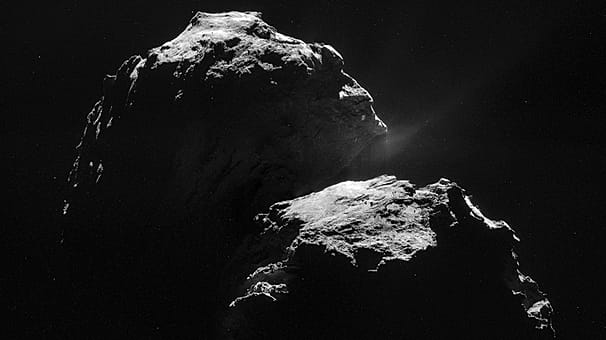
The Philae Probe successfully lands on a comet for the first time in human history


Hey, check this out.

http://cdni.wired.co.uk/1920x1280/o_r/rosetta-comet.jpg

Pretty cool huh?

That’s a comet. Yeah that.

These are the things that people in the past thought were omens of death and drought and illness and stuff. Guess they don’t look as ominous as we once thought they were.

It's not a sign of the devil; it's just a rock dude.
http://i.space.com/images/i/000/003/719/i02/
080908-comet-02.jpg?1292267774


Main thing though, is that the picture isn’t an artist’s drawing or taken by superman. 

We were the ones who took it.


On March 2nd, 2004, The Orbiter carrying the Philae probe was launched from earth to begin its 6.4 billion kilometer journey towards comet 67P/Churyumov-Gerasimenko.

On February 26th, 2015, 16:03 GMT, the successful touchdown of the Philae probe was immediately confirmed by ESOC and DLR’s Lander Control Center. Source

Now unless you’re a dedicated member of the flat earth society or have been living under a rock for the past decade or two, you should know that this is one of the most historic events in space exploration. 

We have gone beyond the moon, and secured our place on one of the most elusive objects of myths.

Process

After 10 years in space, the Rosetta orbiter closes in on its prey. Rosetta took a rather unorthodox path towards the comet. It utilized the gravity of earth and mars to slingshot itself out towards Jupiter. After waking from deep space hibernation, it lined itself up with the comet’s path on the return trip and began closing in. Source

The Philae Lander
http://i.ytimg.com/vi/PBXvUK8EsUM/maxresdefault.jpg
The Rosetta Orbiter
www.jpl.nasa.gov

The most elaborate trick shot in human history
http://images-cdn.9gag.com/photo/avZGG4q_460sa_v1.gif

After it the orbiter was caught into the comet’s gravitational pull, it performs a series of maneuvers to reduce its distance from about 100 kilometers down to 25 kilometers. When Rosetta is just 2.5 kilometers from the nucleus, the Philae probe will be deployed and begin its seven hour journey down onto the comet. The probe, equipped with solar panels, drill bits, magnetometers (though sadly no lasers) will be able to analyze the surface of the comet with unprecedented accuracy. Source

The Amazing Philae Lander in all its glory (but without lasers)
phys.org

Dubbed the seven hours of terror, the NASA scientists squirmed in nervous tension a gadget worth the income of a small country plummeted towards the barren rock. Given the low gravitational pull of the comet, the Philae lander, with a mass of 100 kilograms, would have weighed the equivalent of just 1 gram on earth.

Philae departs
Godspeed, Philae Lander! Final Shot taken while leaving the Rosetta
http://www.bbc.com/news/live/science-environment-29985988

The landing came close to failing. 

On its initial contact, one of the anchoring harpoons failed to launch, and the probe rebounded off the surface of the planet at a speed of 15 inches per second. Had it reached the escape velocity of 17 inches per second, the probe would have left the gravitational pull of the comet and be floating in the blackness of space. Presently, it sits safely on rough terrain in the shadow of a nearby cliff, and is slanted at an angle of 30 degrees. Source

But nonetheless, after 10 years and four billion miles, we've finally done it.

How the landing should have went
http://media.giphy.com/media/3rgXBue1jWOl8ZhlcY/giphy.gif


We sure came lucky there. But let’s not concentrate on what could’ve happened.


Work on the Comet

The Philae has a primary battery that would put your pitiful little IPhone charge life to shame. Despite its capacity, however, it only had enough energy to power the probe for 60 hours. Philae originally hit the flat, sunny region that had been carefully selected as its landing spot, but after the acrobatics, it ended up 1 kilo­metre away on its side, in the shadow of a rocky-looking cliff face. From this inelegant position, it did not have enough power to charge its secondary batteries. Source

All hope is not lost, however. Project manager Stephan Ulmanec said that a few days of sunlight for the solar panels is all it would take for it to wake up again. By August 15th, the comet might be close enough to the sun to allow for that extra boost of much-needed sunlight.

Luckily however, it didn’t die out on us before beaming back some amazing data. Organic molecules were immediately detected on the surface, and although there wasn’t enough power for sub-surface chemical analysis, it did send back some kick-butt photos.

Surface of the Comet
http://www.ctvnews.ca/polopoly_fs/1.2101442.1415924022!/httpImage/image.jpg_gen/derivatives/landscape_960/image.jpg
Approaching the landing site
http://static.euronews.com/articles/288124/606x340_288124.jpg?1415781506

The Comet's Desolate Surface
http://images.techtimes.com/data/images/full/25494/comet-67p-churyumov-gerasimenko.jpg


Why Bother?

So who cares? Just about everyone, I guess.

Comets are cold. And old. Older than humans. Older than the earth.

They are the excluded cosmic raisins that birthed from the huge primordial cloud of gas, dust, and ice that later formed literally everything. These comets were too far away to be melted by radiation from the sun; as such, their compositions have remained unchanged for more than four billion years. These comets carry the original ingredients of our earth. We already know that they contain lots of water, ice, and some organic molecules. These ingredients, when put together, can form the basic building blocks of life.
mmm... cosmic raisins
http://www.planetsforkids.org/images/comet-for-kids-2.jpg

We’re not saying there’s going to be aliens on that comet, but the ingredients for life on earth may have been delivered by these celestial bodies.


The Philae Lander’s ability to dig directly into the surface of the planet is exactly what’s so exciting. We now have the opportunity to know about these comets more in-depth than ever before, and possibly gain invaluable evidence for some very prominent hypothesis.

We may actually be aliens... though a lot more better looking
http://cdn.bloody-disgusting.com/wp-content/uploads/2014/11/giphy1.gif


This is primary exploration, where humans, through the artificial senses of robots, are literally going where no one has gone before.


This is fundamental science. data collection. number crunching. While it may not seem like the new iphone or the next candy crush, we are pushing the very limits of human capability, and breaking through what we originally thought was impossible.


And if that's what drives us... damn, who knows what will be possible?


List of sources:

http://www.nature.com/news/philae-s-64-hours-of-comet-science-yield-rich-data-1.16374
http://www.bbc.com/news/live/science-environment-29985988
http://en.wikipedia.org/wiki/Philae_%28spacecraft%29


Thursday, 26 February 2015

Theoretical Physics, Relativity, and Ladders

The Problem

Meet you.

You’re an aspiring young roof tiler. Your boss is horrible, your coworkers are stuck up veterans, and you make below the minimum wage, despite working overtime. But you need to pay off that college debt from your master’s degree in theoretical physics, so you put up with it all anyway.

This is You (representation)

When you arrive home one night, you realize that the new ladder you bought didn’t fit into your garage; it was simply too long, and the folding mechanism was broken. Since you’re already behind on your electrical bills, you can’t afford to have it stolen in the middle of the night. Getting it in the garage is your top priority, and you’d do anything to do it.

But then you have an idea.

You tap into the grueling 8 years of your life you spent studying theoretical physics and formulate a solution. You understand that according to the principles of special relativity, when an object is moving relative to another observer, that object will be horizontally compressed in the direction that the object is moving. This is known as Lorentz contraction, and it can be calculated exactly. The closer the object moves to the speed of light, the more compressed the object will become.

Operating under this principle, you call two of your best buddies, Bob and Mark, to come and manage the doors on either side of the garage. The plan is that you will accelerate the ladder close to the speed of light towards the garage. You know that relative to Bob and Mark, you and the ladder will contract in length to the point where the ladder could fit inside the garage. Once you and the ladder enter the garage, the two of them will slam the two doors shut, trapping the ladder inside.

But no! Mark, who also has a master’s degree in theoretical physics, says. If you do that, sure, the ladder’s length will contract relative to us. But relative to you with the ladder, the garage will be the one that contracts in length! How do you expect us to close the doors when the garage will be even smaller than before!

What you think Mark will see
What Mark thinks you will see


But you know that there can only be one possible outcome: either the ladder will fit, or the ladder won’t fit. You can’t have two conflicting outcomes in the same timeline. So that being said, will your method work in getting the ladder inside the garage?

The Solution


The solution to the apparent paradox lies in the relativity of simultaneity. This means that what one observer (Bob or Mark) considers to be two simultaneous events may not, in fact, be simultaneous to another observer (you). When you want the ladder to “fit” inside the garage, you essentially want, at one specific time, for the position of the back of the ladder and the position of the front of the ladder to be both inside the garage simultaneously. But since simultaneity is relative, both you and Mark can disagree whether or not the ladder fits without contradiction.

To imagine this, let’s say that at one point, Mark and Bob both close the doors and open them immediately again as the ladder passes through the garage. In the frame of reference of Mark and Bob, the ladder would fit, as they could close the doors. From your perspective however, it would be rather different. You would first see the front end of the ladder approach the exit door of the garage. The exit door closes, and opens again allowing for the ladder to pass through. At the same time, the back of the ladder passes through the entrance door, which closes and then opens. In this case, the two doors closing were not necessarily simultaneous relative to you, and the ladder didn’t fit inside the garage.
From your frame of reference, the doors
will not necessarily close at the same time
From Mark and Bob's frame of reference, the doors
will close simultaneously around the ladder


So in the end, will you be able to succeed in locking the ladder into the garage? Well to do that, it means that the exit door will have to remain closed and the front door will also have to remain closed as well. Let’s take a look at this from the frame of the garage. If we assume that the exit door is immovable, it means that once the ladder hits the exit door, it will instantaneously stop. By this time, the entrance door has closed, and the ladder is stuck inside the garage. Since its relative velocity is now zero, and is not length contracted, it is now longer than the garage. The ladder must now bend, snap, or explode. So the question here, this time, is how did we ever get to close the doors to trap it inside in the first place?

The answer again lies with the relativity of simultaneous events. In the garage’s frame, all parts of the ladder decelerated at the same time. However, in your frame of reference, the ladder accelerates sequentially. First the front decelerates, and then the middle, and then the back end of the ladder. By the time the back end of the ladder has decelerated, the entire ladder is already in the garage, after which you can close the back door. Only issue is, after this, that ladder will have to bend or snap to accommodate its new restrictive garage.

So is it a viable method?

Well assuming you can accelerate to about 95% the speed of light, have an immovable garage, extremely fast and hyper coordinated people, and too much time on your hands…


Probably.