Hey, check this out.
 |
| http://cdni.wired.co.uk/1920x1280/o_r/rosetta-comet.jpg |
Pretty cool huh?
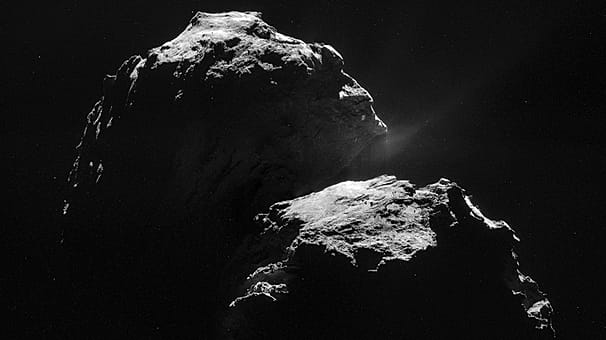
That’s a comet. Yeah that.
These are the things that people in the past thought were
omens of death and drought and illness and stuff. Guess they don’t look as
ominous as we once thought they were.
 |
| It's not a sign of the devil; it's just a rock dude. http://i.space.com/images/i/000/003/719/i02/ 080908-comet-02.jpg?1292267774 |
Main thing though, is that the picture isn’t an artist’s
drawing or taken by superman.
We were the ones who took it.
On March 2nd, 2004, The Orbiter carrying the
Philae probe was launched from earth to begin its 6.4 billion kilometer journey
towards comet 67P/Churyumov-Gerasimenko.
On February 26th, 2015, 16:03 GMT, the successful
touchdown of the Philae probe was immediately confirmed by ESOC and DLR’s
Lander Control Center. Source
Now unless you’re a dedicated member of the flat earth
society or have been living under a rock for the past decade or two, you should
know that this is one of the most historic events in space exploration.
Process
After 10 years in space, the Rosetta orbiter closes in on
its prey. Rosetta took a rather unorthodox path towards the comet. It utilized
the gravity of earth and mars to slingshot itself out towards Jupiter. After
waking from deep space hibernation, it lined itself up with the comet’s path on
the return trip and began closing in. Source
 |
| The Philae Lander http://i.ytimg.com/vi/PBXvUK8EsUM/maxresdefault.jpg |
 |
| The Rosetta Orbiter |
 |
| The most elaborate trick shot in human history http://images-cdn.9gag.com/photo/avZGG4q_460sa_v1.gif |
After it the orbiter was caught into the comet’s
gravitational pull, it performs a series of maneuvers to reduce its distance
from about 100 kilometers down to 25 kilometers. When Rosetta is just 2.5
kilometers from the nucleus, the Philae probe will be deployed and begin its
seven hour journey down onto the comet. The probe, equipped with solar panels,
drill bits, magnetometers (though sadly no lasers) will be able to analyze the
surface of the comet with unprecedented accuracy. Source
 |
| The Amazing Philae Lander in all its glory (but without lasers) |
Dubbed the seven hours of terror, the NASA scientists
squirmed in nervous tension a gadget worth the income of a small country
plummeted towards the barren rock. Given the low gravitational pull of the
comet, the Philae lander, with a mass of 100 kilograms, would have weighed the equivalent
of just 1 gram on earth.
 |
| Godspeed, Philae Lander! Final Shot taken while leaving the Rosetta http://www.bbc.com/news/live/science-environment-29985988 |
The landing came close to failing.
On its initial contact,
one of the anchoring harpoons failed to launch, and the probe rebounded off the
surface of the planet at a speed of 15 inches per second. Had it reached the
escape velocity of 17 inches per second, the probe would have left the
gravitational pull of the comet and be floating in the blackness of space. Presently,
it sits safely on rough terrain in the shadow of a nearby cliff, and is slanted
at an angle of 30 degrees. Source
But nonetheless, after 10 years and four billion miles, we've finally
done it.
 |
| How the landing should have went http://media.giphy.com/media/3rgXBue1jWOl8ZhlcY/giphy.gif |
We sure came lucky there. But let’s not concentrate on what
could’ve happened.
Work on the Comet
The Philae has a primary battery that would put your pitiful
little IPhone charge life to shame. Despite its capacity, however, it only had
enough energy to power the probe for 60 hours. Philae originally hit the flat,
sunny region that had been carefully selected as its landing spot, but after the
acrobatics, it ended up 1 kilometre away on its side, in the shadow of a rocky-looking cliff face. From this
inelegant position, it did not have enough power to charge its secondary
batteries. Source
All hope is not lost, however. Project manager Stephan
Ulmanec said that a few days of sunlight for the solar panels is all it would
take for it to wake up again. By August 15th, the comet might be
close enough to the sun to allow for that extra boost of much-needed sunlight.
Luckily however, it didn’t die out on us before beaming back
some amazing data. Organic molecules were immediately detected on the surface,
and although there wasn’t enough power for sub-surface chemical analysis, it
did send back some kick-butt photos.
 |
| Surface of the Comet http://www.ctvnews.ca/polopoly_fs/1.2101442.1415924022!/httpImage/image.jpg_gen/derivatives/landscape_960/image.jpg |
 |
| Approaching the landing site http://static.euronews.com/articles/288124/606x340_288124.jpg?1415781506 |
 |
| The Comet's Desolate Surface http://images.techtimes.com/data/images/full/25494/comet-67p-churyumov-gerasimenko.jpg |
Why Bother?
So who cares? Just about everyone, I guess.
Comets are cold. And old. Older than humans. Older than the
earth.
They are the excluded cosmic raisins that birthed from the
huge primordial cloud of gas, dust, and ice that later formed literally
everything. These comets were too far away to be melted by radiation from the
sun; as such, their compositions have remained unchanged for more than four
billion years. These comets carry the original ingredients of our earth. We
already know that they contain lots of water, ice, and some organic molecules. These
ingredients, when put together, can form the basic building blocks of life.
 |
| mmm... cosmic raisins http://www.planetsforkids.org/images/comet-for-kids-2.jpg |
We’re not saying there’s going to be aliens on that comet,
but the ingredients for life on earth may have been delivered by these
celestial bodies.
The Philae Lander’s ability to dig directly into the surface
of the planet is exactly what’s so exciting. We now have the opportunity to
know about these comets more in-depth than ever before, and possibly gain
invaluable evidence for some very prominent hypothesis.
 |
| We may actually be aliens... though a lot more better looking http://cdn.bloody-disgusting.com/wp-content/uploads/2014/11/giphy1.gif |
This is primary exploration, where humans, through the
artificial senses of robots, are literally going where no one has gone before.
This is fundamental science. data collection. number crunching. While it may not seem like the new iphone or the next candy crush, we are pushing the very limits of human capability, and breaking through what we originally thought was impossible.
And if that's what drives us... damn, who knows what will be possible?
http://www.nature.com/news/philae-s-64-hours-of-comet-science-yield-rich-data-1.16374
http://www.bbc.com/news/live/science-environment-29985988
http://en.wikipedia.org/wiki/Philae_%28spacecraft%29

No comments:
Post a Comment